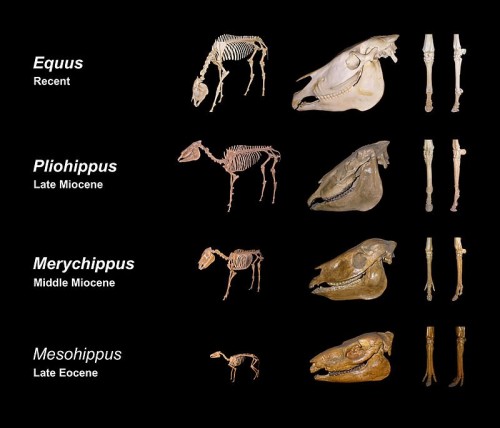
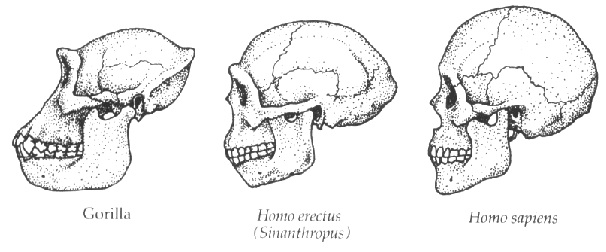
Image source
Speciation: Due to natural variation between individuals, selection pressure, “survival of the fittest” and favourable traits being passed on to offspring over many generations, new species are formed. Biologists refer to allopatric (geographical), sympatric (same location and habitat), and parapatric (habitat differences) speciation.
Divergent Evolution: Over time, due to selection pressures, sub-species or species become less and less alike, as they become better adapted to their niche. Adaptive radiation (below) is a specific type of divergent evolution. The human foot and the foot of a chimpanzee is an example – they are quite different (divergent), although they evolved from a common ancestor, due to the differing habitats of the upright walking man, compared to the knuckle-walking chimpanzee.
Adaptive Radiation: The process by which organisms change over generations to fill different niches, especially when changes in the environment make new resources available. Charles Darwin famously documented the different beak shapes of finches on the Galapagos Islands, which he postulated had arisen form a common ancestor. Above, you can see the variations of honeycreepers from the Hawaiian islands.
Convergent Evolution: In this form of change over time, different species begin to look more alike, despite having no recent common ancestor. Analogous structures develop, that have the same form and function, but were not present in the most recent common ancestor. Examples include flying insects, birds and bats, who have all developed wings as a solution to escaping from predators or finding more food and mates. Hedgehogs and echidnas are a good example of convergent evolution.
Parallel Evolution: Parallel evolution is similar to convergent evolution, in that different organisms display similar characterisitics, but tend to be more closely related. So, gliding frogs for example, evolved in parallel from multiple types of tree frog. Some examples that are closer to home include the Tasmanian tiger and the European wolf; the flying squirrel and gliding possums and marsupial and placental moles/mice.
More about patterns of evolution: